

Praying at 12 AM and 3 AM Explained: Christian & Islamic Guide
Praying at 12 AM and 3 AM explained: Midnight prayer (12 AM) focuses on spiritual warfare and breakthrough — Paul and Silas prayed at midnight and their chains broke (Acts 16:25). Praying at 3 AM, the fourth watch, is associated with divine visitation and deep communion with God. In Islam, 3 AM aligns with Tahajjud — the most powerful voluntary night prayer.
Have you ever woken up at 3 AM and felt a sudden pull to pray? You are not alone — and it is not a coincidence.
Praying at 12 AM and 3 AM is one of the most searched spiritual topics today, and for good reason. Both Christianity and Islam regard the night hours — especially midnight and the pre-dawn window — as uniquely powerful times to connect with God. Yet most articles only cover one faith’s perspective.
This guide covers both. Whether you are a Christian who wants to understand the biblical foundation of midnight prayer or a Muslim seeking to understand how Tahajjud relates to these sacred hours, you will find everything you need here — including practical prayer points you can use tonight.
What Is the Difference Between Praying at 12 AM and 3 AM?
Praying at 12 AM and 3 AM are two distinct spiritual practices, even though they are close in time. The midnight hour carries the weight of divine intervention and spiritual warfare. The 3 AM hour is gentler — it is associated with communion, peace, and divine visitation. Neither is commanded in scripture; both are chosen acts of love by believers who refuse to let the night pass without seeking God.
| Feature | 12 AM (Midnight) | 3 AM (Fourth Watch) |
|---|---|---|
| Biblical theme | Warfare, breakthrough, deliverance | Divine visitation, peace, communion |
| Key Bible event | Paul & Silas — chains broken (Acts 16:25) | Jesus walks on water (Matthew 14:25) |
| Islamic connection | First part of last third of night | Peak Tahajjud time — closest to Fajr |
| Prayer watch | Third Watch (12–3 AM) | Fourth Watch (3–6 AM) |
| Tone of prayer | Bold, declarative, intercession | Quiet, intimate, surrendered |
| Who benefits most | Those facing spiritual battles, bondage, family crisis | Those seeking healing, peace, direction |
The simplest way to remember it: midnight is when you fight; 3 AM is when you listen.
What the Bible Says About Praying at 12 AM (Midnight)
The Bible never commands Christians to pray specifically at midnight — but it records some of the most dramatic divine interventions happening at exactly that hour. Midnight prayer in scripture is always connected to breakthrough.
Paul and Silas (Acts 16:25–26)
The most powerful midnight prayer story in all of scripture. Paul and Silas had been beaten, chained, and thrown into the innermost prison. At midnight, instead of crying or sleeping, they prayed and sang hymns to God. The result? An earthquake shook the prison, every door opened, and every chain fell off. Acts 16:25–26 establishes midnight as the hour of supernatural chains breaking — in your circumstances, your family, your health, your spiritual life.
God Moved at Midnight for Israel’s Deliverance (Exodus 12:29)
The tenth plague — the death of the firstborn — struck Egypt at midnight. But for Israel, midnight was the hour God passed over their homes and moved them toward freedom. Midnight is not only for danger — it is the hour God delivers His people.
David’s Midnight Gratitude (Psalm 119:62)
King David rose at midnight to give thanks to God for His righteous laws. David was not driven by crisis — he rose at midnight out of pure love and gratitude. This shows that midnight prayer is not only for emergencies; it is a discipline of devotion.
Matthew 13:25 — The Enemy Works at Night
Jesus warned in the parable of the wheat and tares that the enemy comes while men sleep and sows weeds among the wheat. This verse is a spiritual principle: the hours when most people are unconscious are when the enemy moves. Midnight prayer is how believers stay spiritually awake and on guard.
The 8 Prayer Watches of the Night
| Watch | Time | Spiritual Focus |
|---|---|---|
| First Watch | 6 PM – 9 PM | Family intercession, protection of the home |
| Second Watch | 9 PM – 12 AM | Warfare, binding evil assignments |
| Third Watch | 12 AM – 3 AM | Breakthrough prayer, chains breaking |
| Fourth Watch | 3 AM – 6 AM | Divine visitation, revelation, peace |
| Fifth Watch | 6 AM – 9 AM | Morning consecration, the day’s agenda |
| Sixth Watch | 9 AM – 12 PM | Ministry and work, Kingdom assignments |
| Seventh Watch | 12 PM – 3 PM | Midday renewal, the hour of the Cross |
| Eighth Watch | 3 PM – 6 PM | Mercy, redemption, the hour Jesus died |
Why Midnight Prayer Feels More Intense
There is a scientific reason midnight prayer can feel especially powerful: cortisol levels are at their lowest, the mind is quieter, and external distractions are absent. Spiritually, the Bible frames midnight as a threshold hour — a moment between the old and the new, the bound and the free. Many prayer warriors report that spiritual activity — both demonic and angelic — is more perceptible at midnight. Learn more about spiritual warfare prayers and how to pray against enemy assignments.
What the Bible Says About Praying at 3 AM
The 3 AM hour is what scripture calls the fourth watch of the night (3–6 AM). This is the hour associated with divine appearances, supernatural calm, and God coming to His people in their most vulnerable moments.
Matthew 14:25 — Jesus Walks on Water
After spending the evening alone on a mountain in prayer, Jesus came to His disciples walking on water during the fourth watch of the night. He came to them — not during the comfortable daylight hours, but in the darkest, most frightening part of the night. This sets 3 AM as the hour of divine arrival and rescue.
Mark 1:35 — Jesus Prayed Before Dawn
One of the most personal glimpses into Jesus’ prayer life: He rose very early in the morning, while it was still dark, went to a solitary place, and prayed. Many scholars believe this was the fourth watch — between 3 and 6 AM. If Jesus needed pre-dawn solitary prayer, there is a lesson here for every believer.
Lamentations 2:19 — Arise and Cry Out in the Night
Written in the context of extreme suffering, this verse calls believers to “arise, cry out in the night, at the beginning of the night watches.” This is one of the clearest prophetic invitations to night prayer found in scripture — and it was written not in victory, but in pain. Midnight and 3 AM prayer is not just for the strong; it is for the desperate, too.
The Third Watch Explained
In the Jewish reckoning of night hours (used in the Old Testament), the night was divided into three watches. The third watch ran from midnight to 3 AM — the deepest part of the night. In the Roman system used in the New Testament, it was divided into four, making the fourth watch (3–6 AM) the pre-dawn hour. This is why you will see different “watch” charts in different resources. Both frameworks agree on the spiritual weight of the midnight-to-dawn window.
Why 3 AM Is Called the Hour of Divine Visitation
Across Christian traditions worldwide — Pentecostal, Catholic, Orthodox, Protestant — believers have reported waking at 3 AM with a profound sense of God’s presence. Many revivals and healing testimonies trace back to pre-dawn prayer. Theologically, there is no command to pray at exactly 3 AM. But the consistent biblical pattern of God appearing, acting, and speaking in the night’s final hours has given this time a sacred reputation. See also our guide to powerful morning prayers that you can flow into from your night prayers.

Islamic Perspective — Tahajjud and Midnight Prayer
This is where wishandprayers.com stands completely apart from every other article on this topic: no competing site has fully explained the Islamic night prayer alongside the Christian midnight prayer. For a faith-based site serving both audiences, this section is essential.
What Is Tahajjud?
Tahajjud (تهجد) is a voluntary Islamic night prayer performed after the obligatory Isha prayer and before the Fajr (dawn) prayer. It is one of the most emphasized optional acts of worship in the Quran and Sunnah.
Allah says in Surah Al-Isra (17:79): “And of the night, wake up a part of it as an additional prayer for you; your Lord will raise you to a praised station.” This verse directly connects night prayer — Tahajjud — to divine elevation and answered supplication.
The Last Third of the Night — When Allah Descends
A well-known Hadith narrated in Sahih Bukhari and Sahih Muslim states that Allah descends to the lowest heaven during the last third of every night and calls out: “Who is calling upon Me, that I may answer? Who is asking of Me, that I may give? Who is seeking My forgiveness, that I may forgive?”
In most parts of the world, the last third of the night falls roughly between 1 AM and the Fajr prayer — which means both 12 AM and 3 AM can fall within Tahajjud time, depending on your location and the season. You can check accurate Tahajjud times on Sunnah.com.
12 AM vs 3 AM in Islam — Which Is Better for Tahajjud?
Islamic scholars agree that the closer to Fajr you pray Tahajjud, the more blessed the prayer. This means 3 AM is generally superior to midnight in the Islamic framework — but both fall within the accepted Tahajjud window. If you can only wake once, the pre-Fajr window (approximately 3–4 AM in most regions) is the optimal time.
How Christians and Muslims Both Agree on the Power of Midnight Prayer
At first glance, Christian midnight prayer and Islamic Tahajjud seem very different. But step back and the agreement is striking:
- Both traditions teach that night prayer is voluntary but spiritually superior to daytime prayer
- Both connect the night hours to breakthrough and answered prayer
- Both emphasize waking from sleep as an act of love and sacrifice for God
- Both traditions produce the most spiritually transformed believers among those who practice consistent night prayer
This convergence is one of the most beautiful examples of how the Abrahamic faiths share deep spiritual truths. You can also explore bedtime prayers for stress that both Christian and Muslim readers use to prepare for a night of worship.
Practical Differences: Islamic Wudu + Salah vs Christian Freestyle Prayer
Islamic Tahajjud follows a defined structure: the worshiper must first perform Wudu (ritual purification), then pray between 2 and 8 optional Rak’ahs (units of prayer), then close with the Witr prayer, and finally make personal Du’a (supplication). Christian midnight prayer is free-form — it may include praise, scripture reading, spiritual warfare declarations, intercessory prayer, or simply sitting in silence before God. Both approaches are valid within their respective traditions.
Benefits of Praying at 12 AM and 3 AM
Why would anyone voluntarily lose sleep to pray? People who practice midnight and pre-dawn prayer consistently across both faiths report profound changes in their lives — spiritually, mentally, and even physically.
Spiritual Benefits
- Breakthrough in stubborn situations — Acts 16:25–26 is the prototype: chains break at midnight
- Protection over family and home — the intercessor stands in the gap while others sleep
- Heightened spiritual sensitivity — regular night prayer sharpens discernment
- Deeper intimacy with God — sacrifice of sleep communicates total devotion
- Spiritual warfare advantage — engaging the enemy’s “sowing time” (Matthew 13:25) with prayer neutralizes night-season attacks
See related: Prayers to Destroy the Works of the Enemy — directly applicable to midnight spiritual warfare.
Physical Benefits
- The world is genuinely quieter at night — no notifications, no noise
- Cortisol (the stress hormone) is at its lowest around 1–3 AM, making the mind more receptive
- Many people report returning to deeper sleep after midnight prayer — the act of surrender to God appears to reduce overnight anxiety
7 Signs God Is Calling You to Pray at These Hours
- You keep waking at the same time every night for no clear reason
- You feel a heaviness or urgency when you first open your eyes
- You have vivid dreams that seem spiritually significant near midnight
- Someone on your heart — a family member, a situation — keeps coming to mind at night
- You feel unusual peace when you actually get up and pray
- You have been going through a season of spiritual warfare or prolonged unanswered prayer
- You recently read or heard teaching on midnight prayer and felt strongly moved
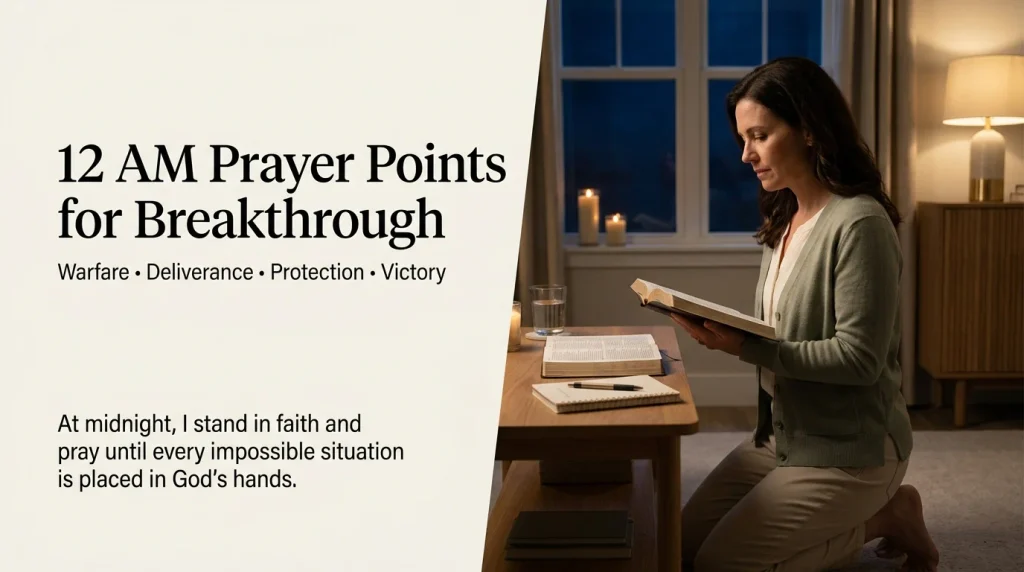
12 AM Prayer Points for Breakthrough & Spiritual Warfare
These 10 midnight prayer points are designed for bold, faith-filled declaration — the kind of prayer Paul and Silas demonstrated at midnight. Speak each point out loud with confidence, backed by the Word of God.
- Breaking Chains of Bondage
“Father, just as You broke the chains of Paul and Silas at midnight, I declare that every chain of fear, addiction, and spiritual bondage in my life is broken right now. Acts 16:25–26.” - Divine Breakthrough in Delay
“Lord, I arise at this midnight hour to cry out for the breakthrough I have been waiting for. You are not slow. Your timing is perfect. I receive my miracle tonight. Habakkuk 2:3.” - Protection Over My Family
“Father, just as the blood of the lamb protected Israel at midnight (Exodus 12:29), I cover my family with the blood of Jesus. No evil shall come near our dwelling. Psalm 91:10.” - Destroying Night-Season Attacks
“I command every assignment of the enemy that operates while men sleep to be exposed and destroyed. No weapon formed against me in this night shall prosper. Isaiah 54:17.” - Financial Breakthrough Declaration
“Lord, I release my finances into Your hands at this midnight hour. Open doors of provision that no man can shut. Philippians 4:19.” - Deliverance for Prodigal Family Members
“Father, I stand in the gap at midnight for [name]. Return them to You. Break every spiritual deception over their mind. Luke 15:24.” - Releasing Praise as a Weapon
“I will not be silent at midnight. Like David, I rise to praise You. My praise breaks strongholds. You inhabit my praise. Psalm 22:3.” - Healing Declaration
“By the stripes of Jesus I am healed — spirit, soul, and body. I receive supernatural healing as I wait before You in this midnight hour. 1 Peter 2:24.” - Spiritual Vision and Clarity
“Lord, in this dark hour, give me the light of Your Word. Show me the path forward. Let Your lamp guide my feet. Psalm 119:105.” - Intercession for the Nations
“Father, I intercede at midnight for those in darkness — nations, cities, leaders. Let Your Kingdom come and Your will be done on earth as it is in heaven. Matthew 6:10.”
For a deeper collection of breakthrough intercession, see our guide to heart-touching prayers for personal breakthrough.
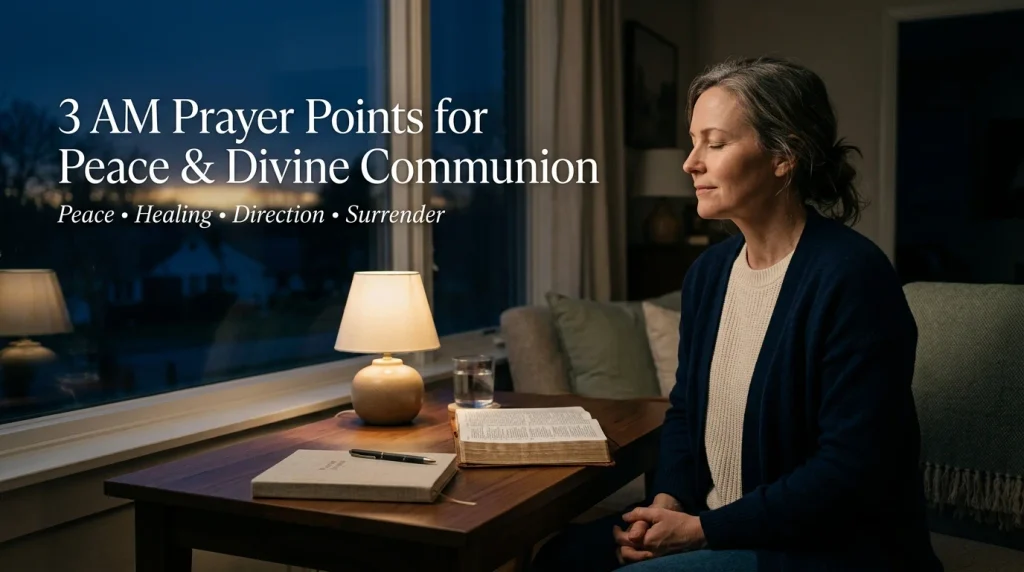
3 AM Prayer Points for Peace & Divine Communion
These 10 prayer points for 3 AM are quieter and more intimate in tone. The fourth watch is about drawing close, listening, and receiving. Come to these prayers with an open heart — not just with a list of requests.
- Invitation for Divine Presence
“Lord, I have risen at this early hour to seek Your face. Come, Lord — meet me here in the fourth watch. I am listening. Matthew 14:25.”
Islamic parallel: “Allahumma lakal hamd, Anta qayyimus samawati wal ard.” (O Allah, to You belongs all praise, You are the Sustainer of the heavens and earth.) - Prayer for Inner Peace
“Father, I release every anxiety and worry that woke me at this hour. Your peace which surpasses all understanding guards my heart and mind in Christ Jesus. Philippians 4:7.” - Prayer for Healing
“Lord, I bring before You every broken place — in my body, my emotions, my relationships. You are Jehovah Rapha, the God who heals. Let Your healing come now in this quiet hour.” - Seeking Divine Direction
“Father, I do not know which way to turn in this season. Speak. I am still. Show me the path — the one You have already prepared. Proverbs 3:5–6.” - Gratitude Prayer (Tahajjud-style)
“I rise at 3 AM not with a request but with thanksgiving. You gave me another night. You protected my sleep. You hold tomorrow. Thank You, Lord.” - Prayer for Forgiveness and Cleansing
“Lord, cleanse me from every sin I am aware of and every hidden fault. Renew a right spirit within me as I kneel before You in this still hour. Psalm 51:10.”
Islamic Du’a: “Astaghfirullaha rabbi min kulli dhambin wa atubu ilayh.” (I seek the forgiveness of Allah, my Lord, from every sin and I repent to Him.) - Intercession for the Suffering
“Father, at this 3 AM hour, someone in my city, in this nation, is in pain. I stand with them in prayer. Send angels of comfort. Let no one be alone in their suffering tonight.” - Declaration of God’s Faithfulness
“Great is Your faithfulness, Lord. The compassions of God are new every morning — and that morning is almost here. I declare Your faithfulness over my life. Lamentations 3:22–23.” - Surrender Prayer
“I lay down my agenda, my plans, and my fears at 3 AM. Not my will, but Yours be done. I trust You with everything I cannot control. Luke 22:42.” - Awakening and Revival Prayer
“Lord, let there be an awakening — in me, in my family, in my church, in this generation. As the dawn approaches, let revival fire fall. Habakkuk 3:2.”
Related reading: Short Prayers for Healing — perfect for the quiet intimacy of the 3 AM hour. You may also find our prayers to calm anxiety helpful if anxiety is what wakes you at 3 AM.
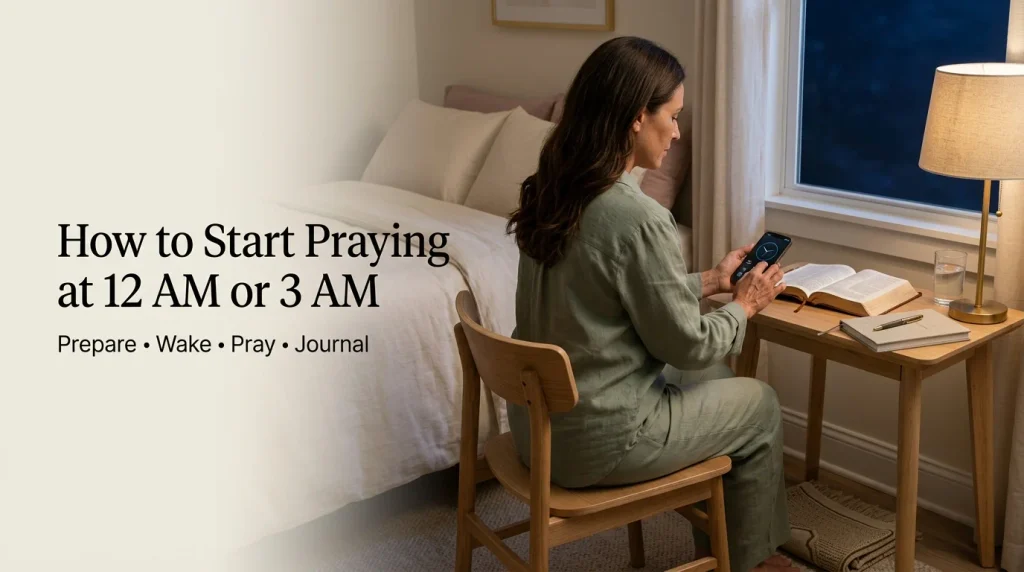
How to Start Praying at 12 AM or 3 AM (Step-by-Step Guide)
You do not need to be a seasoned prayer warrior to begin. Here is a simple, practical way to start.
- Set Your Alarm Intentionally — Start with 2–3 nights per week, not every night. Consistency over intensity. Set your alarm with a purpose — write on your phone why you are waking up.
- Prepare Your Space the Night Before — Leave your Bible or Quran open. Have a notepad nearby. Put a glass of water by your bed. Preparation signals to your spirit that this appointment is real.
- Start With 10–15 Minutes — You do not need to pray for two hours. Begin with 10 quiet minutes. Spend 5 on praise, 5 on your specific prayer. Over time, this grows naturally.
- Use the Prayer Points in This Guide — The lists above give you a starting point. You do not need to be eloquent — God hears the sincere cry, not the polished speech.
- Journal What You Receive — After praying, write any impressions, peace, or scriptures that come to mind. Over months, this journal becomes a testimony of God’s faithfulness in the night hours.
Tips for Beginners
- Do not guilt yourself if you fall back asleep — get up, wash your face, try again
- Drink water first — dehydration makes early rising miserable
- Pray standing or kneeling if possible, not lying down — posture affects alertness
- For Islamic Tahajjud: perform Wudu first, even if it means going to the bathroom — the cold water helps you wake up
What to Do When You Don’t Feel Anything
Feeling is not the measure of effective prayer. Paul and Silas were in chains, beaten, in pain — they did not “feel” breakthrough coming. They prayed anyway, and God moved. Show up at midnight and 3 AM whether you feel spiritual or not. Faithfulness in the dark is what builds the kind of faith that moves mountains.
If you are struggling to pray consistently, our guide on morning prayers for a blessed day can complement your night prayer habit — creating a full bookend of prayer from midnight to dawn to morning.
Frequently Asked Questions
What is the difference between praying at 12 AM and 3 AM?
Praying at 12 AM focuses on spiritual warfare and breakthrough — midnight is when Paul and Silas prayed and chains broke (Acts 16:25). Praying at 3 AM, the fourth watch, is associated with divine visitation, peace, and intimate communion with God. In Islam, 3 AM aligns with Tahajjud, the most powerful voluntary prayer.
What does the Bible say about praying at 3 AM?
The Bible does not command praying at exactly 3 AM, but Matthew 14:25 shows Jesus appearing during the fourth watch (3–6 AM), and Mark 1:35 records Jesus praying before dawn in solitude. Lamentations 2:19 also calls believers to “arise and cry out in the night at the beginning of the watches.”
What is Tahajjud and how does it relate to midnight prayer?
Tahajjud is an optional Islamic night prayer performed after Isha and before Fajr, typically in the last third of the night — around 1–3 AM. It is considered the most powerful voluntary prayer in Islam, similar to how midnight prayer is viewed in Christianity. Both represent waking from sleep as an act of devotion to God.
Is it good to pray at midnight?
Yes — midnight prayer is endorsed in both Christianity and Islam. In the Bible, God moved at midnight for Israel’s deliverance (Exodus 12:29) and broke Paul’s chains (Acts 16:25–26). In Islam, the last third of the night includes midnight and is described in Hadith as the time when Allah descends to answer prayers.
Why is 3 AM considered a holy hour for prayer?
In Christianity, 3 AM is the start of the fourth watch — when Jesus walked on water to rescue His disciples (Matthew 14:25). Many believers report waking at 3 AM with a strong pull to pray. In Islam, the pre-Fajr window overlapping with 3 AM is considered the optimal time for Tahajjud.
What are prayer watches of the night?
Prayer watches divide the night into segments for focused prayer. In the New Testament Roman system, there are four watches: First Watch (6–9 PM), Second Watch (9 PM–12 AM), Third Watch (12–3 AM — the midnight breakthrough hour), and Fourth Watch (3–6 AM — the divine visitation hour).
Can I pray at any time, or does timing matter?
You can pray at any time — God is always accessible. However, midnight and pre-dawn prayer carry extra spiritual weight in both Christianity and Islam because of their biblical and Quranic precedent and the practical advantage of undistracted quiet. The timing is never commanded, but it is consistently rewarded in scripture.
What prayer points should I pray at midnight?
At midnight, focus on spiritual warfare, breaking bondages, protection for your family, intercession for prodigals, financial breakthrough, and declaring God’s faithfulness. The 10 prayer points in this article give you a complete midnight prayer guide with Bible verse support.
What prayer points should I pray at 3 AM?
At 3 AM, focus on intimate communion, surrender, healing, direction, gratitude, and forgiveness. The 3 AM prayer tone is quieter and more receptive than midnight prayer. The 10 prayer points in this guide are designed specifically for the fourth watch spirit.
How do I start praying at midnight if I am a beginner?
Start with 2–3 nights per week, not every night. Set your alarm with intention, prepare your space the evening before, and begin with just 10–15 minutes of prayer. Consistency matters more than duration. Use the step-by-step guide in this article to get started tonight.
What does praying at 3 AM mean spiritually?
Spiritually, 3 AM represents the hour of divine visitation, deep communion, and supernatural encounter. Many believers interpret waking at 3 AM as a divine summons to seek God in the stillness before dawn — a moment when the veil between heaven and earth feels thinnest.
How does Islamic Tahajjud differ from Christian midnight prayer?
Islamic Tahajjud follows a structured format: Wudu, 2–8 optional Rak’ahs, Witr prayer, and personal Du’a. Christian midnight prayer is free-form — it can include praise, scripture, warfare declarations, and silence. Both seek nearness to God in the night’s final hours, making them more complementary than contradictory in spirit.
Conclusion
Praying at 12 AM and 3 AM explained is not just a spiritual concept — it is a practice that has transformed believers across two of the world’s largest faiths for thousands of years. Whether you are a Christian standing in spiritual warfare at midnight or a Muslim rising for Tahajjud before Fajr, the night hours belong to those who refuse to let darkness go unchallenged.
Start tonight. Set your alarm. Pick two or three prayer points from this guide. Show up. You may be surprised what God does in the quiet hours before dawn.
Want to go deeper in your prayer life? Explore these related guides on wishandprayers.com:
- Commanding Your Morning Declarations — continue your night prayer into morning declarations
- Prayers for Forgiveness and Inner Peace
- Prayers for Healing — Christian and Islamic healing prayers
- Prayers for Family and Friends — for your midnight intercession list
- Prayers for Career Success
- Forgiveness Prayers to Heal Your Heart
Written by Sarah Mitchell | Faith content writer covering Christian and Islamic prayer traditions | Reviewed by a faith practitioner | Bible verses sourced from BibleGateway.com | Hadith references verified via Sunnah.com | Content fact-checked against Bible verses and Islamic scholarly consensus